Begin on the ranch, not in an autopsy room. Roswell's contemporary story concerns recovered debris, an Army announcement and a rapid change of explanation.
4 min read · July 1947 · reviewed 28 October 2026
A piece of wreckage can be real while the explanation attached to it is wrong. Roswell became famous because the military's first public description was extraordinary — and its replacement was remarkably ordinary. The interesting question is how the surviving evidence connects those two stories.
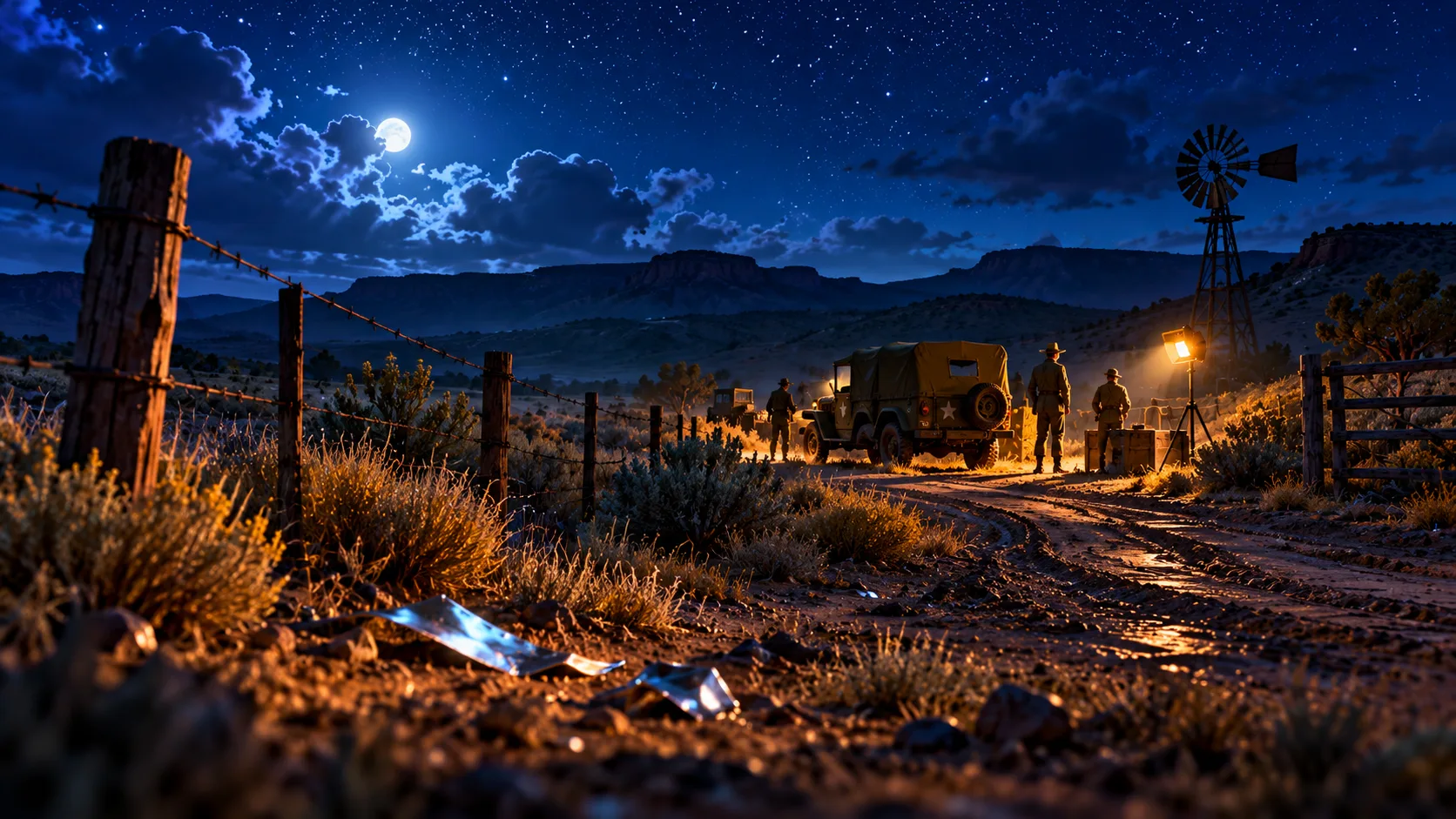
Illustration inspired by the New Mexico setting; not a photograph or reconstruction of the recovery.
Interactive route
Follow the recovery route
Schematic route, not a precise crash-site map. Ranch location and distances vary across accounts.
Stop 1 of 4
Foster Ranch / Corona area
Rancher W. W. 'Mac' Brazel reported scattered material northwest of Roswell. The July newspaper accounts concern a debris discovery, not a photographed intact spacecraft.
Inspect the evidence
Three things to look at closely
Contemporary reporting
The materials in the early account
Rubber, foil-like material, paper and lightweight sticks appear in the early descriptions. Brazel was also reported as saying the find did not resemble weather balloons he had found before. That tension belongs in the story; neither half should be edited out.
Later recollection · 1979
The extraordinary-material claim
Jesse Marcel later described resistant, unusually light fragments and indecipherable markings. He believed the material was not terrestrial. His account is a participant's recollection and interpretation, not a published laboratory analysis of an authenticated sample.
Historical photograph catalogue
The photograph and the missing link
The Fort Worth photographs are genuine historical records. They establish what was displayed in that room. Whether that display represented every recovered item is a separate question about custody, not something a photograph can settle by itself.
An identifiable original sample, a documented chain of custody, or a contemporary technical report would carry more weight than another dramatic retelling. The next room lets you compare the people whose accounts shaped the mystery.